English
- English
- Afrikaans
- беларускі
- Hrvatski
- lugha ya Kiswahili
- ქართული
- Кыргыз тили
- Монгол хэл
- IsiXhosa
- Somali
- O'zbek
- Hawaiian
- Հայերեն
- Español
- Português
- русский
- Français
- 日本語
- Deutsch
- tiếng Việt
- Italiano
- Nederlands
- ภาษาไทย
- Polski
- 한국어
- Svenska
- magyar
- Malay
- বাংলা ভাষার
- Dansk
- Suomi
- हिन्दी
- Pilipino
- Türkçe
- Gaeilge
- العربية
- Indonesia
- تمل
- ελληνικά
- український
- فارسی
- български
- ລາວ
- Latine
- Қазақша
- Azərbaycan
- Македонски
- Lietuvos
- Română
- Srpski језик

How to Choose a Juice Extraction Machine for Your Juice Production Line
Most juice production lines don't fail because someone bought a bad machine. They fail because the machine was chosen before the product was.
It happens constantly. A buyer sees a screw press at a trade show, likes the price, and only later works out that the fruit needs a pulper instead. Another builds an NFC line around a cheap centrifugal unit, then can't explain why the juice turns brown by the second day.
There is an order that works: decide the product, then the fruit, then the capacity. The machine is the last thing you pick.
Extraction is really just three ideas
In a real plant, nobody calls it a juicer. The section is called extraction, and it does one job: break the fruit's cells open, then separate the juice from everything else.
There are only three ways to do that.
· Press it. Squeeze the fruit until the juice runs out. Think of wringing a towel.
· Spin it. Tear the fruit apart at speed and fling the juice out with centrifugal force.
· Pulp it. Grind the flesh into a slurry while pushing stones, seeds and skin out the back.
Every machine below is a version of one of those three, and knowing which family it belongs to tells you most of what it can and can't do.
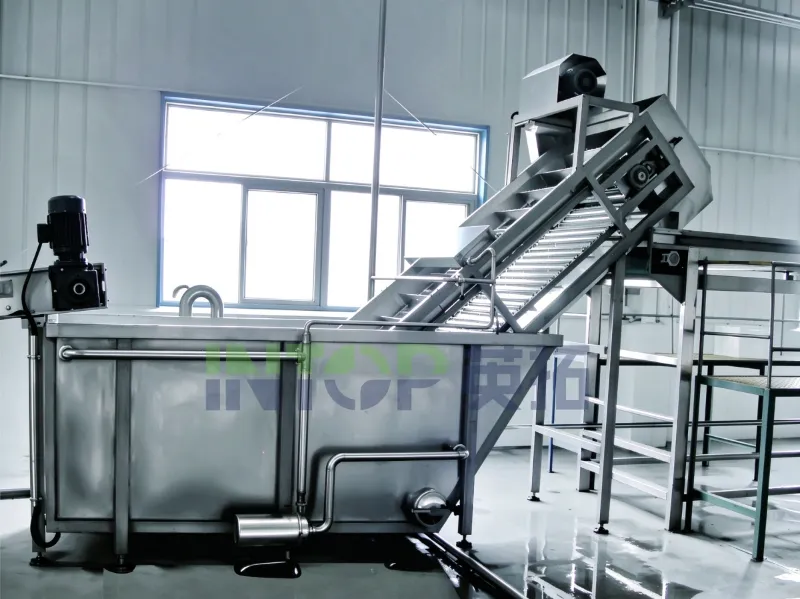
The six machines you'll actually be choosing between
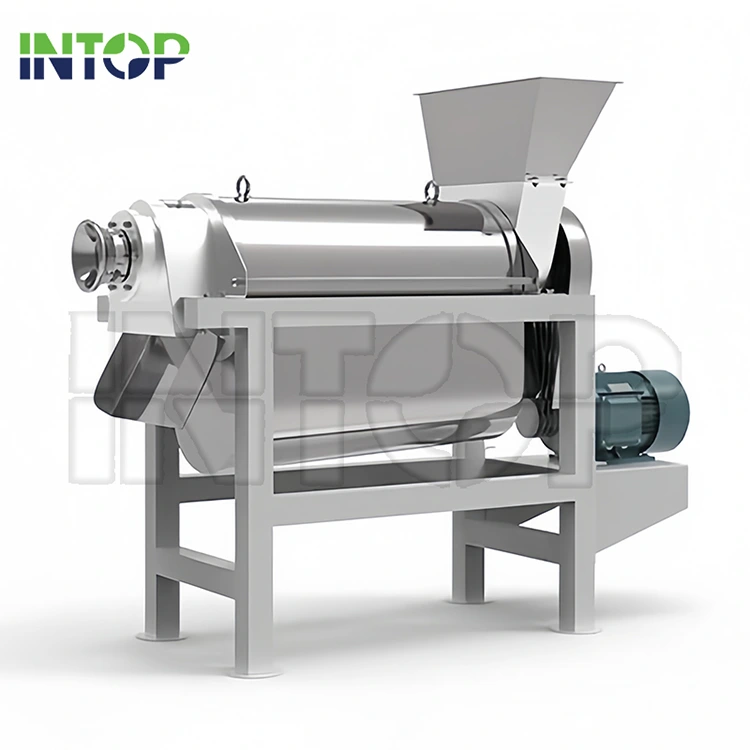
Screw press
Working idea: a toothpaste tube. A tapered screw turns inside a screen cage. Fruit is pushed forward and squeezed harder as it travels, so juice escapes through the screen while pomace exits at the end. Back pressure at the discharge sets how hard it presses.
Suits apples, pears, carrots, pineapple, ginger and most firm root crops. It runs continuously, has few parts and is cheap to keep alive.
The catch is shear. A screw press works the fruit fairly hard and pulls in air as it goes, so on oxidation-sensitive juice, run it slower than you'd like.
Belt press
Working idea: an industrial mangle. Fruit is laid between two filter belts and carried through a wedge zone, then S-shaped rollers, then high-pressure rollers. Each stage squeezes a little harder than the last.
This is the machine behind most large European juice and wine plants. It handles volume well, up to 50 tonnes an hour on the bigger units, and the yield stays steady through a long shift.
What it doesn't like is small batches. A belt press has a minimum throughput, and the belts themselves are a consumable plus a daily cleaning job.
Hydraulic press and bladder press
Working idea: the gentle one. Fruit is stacked in layers or cloth packs and pressed slowly, either by a hydraulic ram or by an inflating rubber bladder that squeezes evenly from one side.
Pressure builds gradually, shear stays low, and oxygen pickup is minimal. For NFC apple, grape and berry juice, where flavour and colour are the whole point, this is often the best answer.
The trade-off is that both are batch machines. Loading and unloading becomes your bottleneck, and bladders wear out and need replacing.
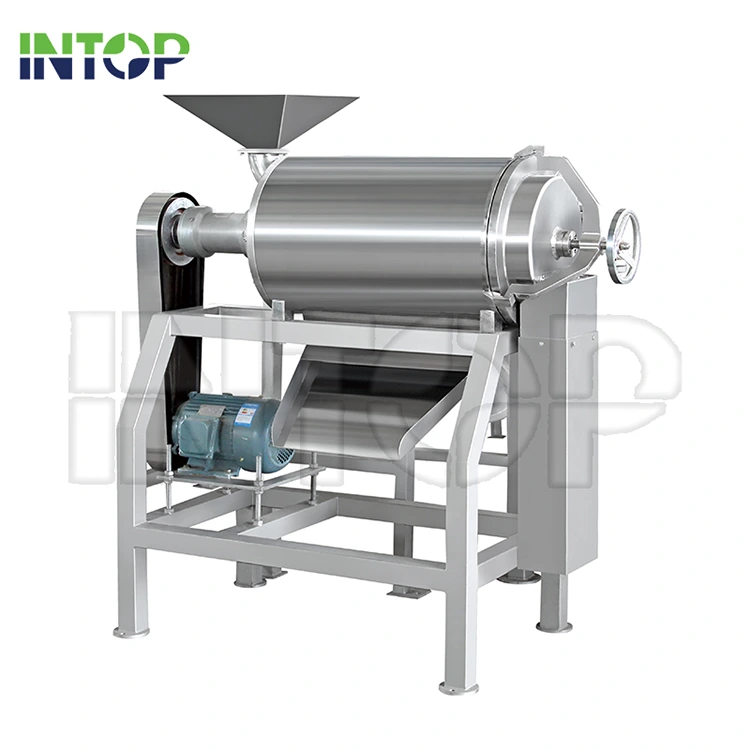
Pulper and finisher
Working idea: a pulp and stone separator. Beaters push fruit through a screen. Soft flesh passes through as purée. Stones, seeds and stems exit at the tail end.
This is the right tool for mango, peach, apricot, tomato, guava and passion fruit, anything with a hard stone that a press would crush and turn bitter.
One number decides everything here: the screen hole size. It sets the texture of the finished product, and it is worth testing two or three screens before you commit.
Citrus half-fruit juicer
Working idea: built for one family of fruit, and only one. The orange is cut in half, then squeezed between two cups inside a closed chamber. Juice leaves through fine holes. Peel, pith and peel oil are taken away separately.
Why it exists is worth understanding. Citrus peel contains limonin and d-limonene. Run an orange through an ordinary press and you crush the peel, which puts bitterness and a numbing aftertaste into the juice, along with oil that wrecks the aroma. That is why orange, grapefruit, lemon and mandarin all go through a dedicated half-fruit machine.
The requirement to plan for is fruit sizing. Different fruit diameters need different cups, so the fruit usually has to be graded before it reaches the machine.
Centrifugal juicer
Working idea: fast, and rough. A high-speed disc shreds the fruit and a basket throws the juice out through a screen.
At a fresh-press counter, or in a small shop with modest volume, it makes sense. Cheap, compact, quick to clean.
On a serious juice production line it usually doesn't. Shredding at that speed whips air into the liquid, and that shows up as browning, foam and lost vitamin C.
Why the yield number on the brochure means nothing
Every supplier will quote you a yield. Treat that number with suspicion.
Yield depends on variety, ripeness, origin, how finely the fruit was crushed, whether enzymes were used, and how the press was set. Run the same machine on two batches of apples from different orchards and you can see a ten-point spread. Same machine, same settings, different fruit.
So the only yield figure that counts is the one produced from your own raw material. Ask the supplier for a pilot test with your fruit, and write the measured result into the technical agreement rather than the brochure figure.
For reference, these are the ranges we typically see:
|
Fruit |
Typical yield |
Usual extraction method |
|
Apple |
65-75%, up to 78% with good preparation |
Screw, belt, hydraulic or bladder press |
|
Orange |
40-50%; 45-55% with flesh on a half-fruit juicer |
Citrus half-fruit juicer |
|
Grape |
65-75% |
Destemmer-crusher plus bladder or hydraulic press |
|
Carrot |
55-65% |
Screw or belt press |
|
Tomato |
75-80% |
Screw, pulper or hot break |
|
Mango |
50-65%, measured as purée |
Pulper and finisher |
|
Blueberry, raspberry |
70-80% |
Bladder or hydraulic press |
Engineering rules of thumb, not promises. Your fruit has the final say.
Clear juice or cloudy juice? This matters more than the machine
Two plants can run the same press and end up with two completely different products, because everything that happens after the press is different.
Clear juice
The target is a bright, see-through liquid. Almost all the work happens downstream. Pectinase and amylase break down the colloids, plate-and-frame or diatomaceous earth filtration takes out the coarse material, ultrafiltration strips the rest of the pectin and protein, and deaeration finishes the job. Aroma recovery can bring the volatiles back if you want them. On this route the press is almost forgiving, as long as it isn't pushing pulp through into the tank.
Cloudy juice and NFC
The target is an even, opaque juice with body. Now the work moves upstream, to the press itself. The machine has to be gentle, with low shear and low oxygen pickup, which usually means a low-speed screw, a hydraulic press or a bladder press rather than a high-speed centrifugal unit. Downstream you homogenise at 20 to 30 MPa to break the pulp particles down so they stay suspended, and deaerate under vacuum to strip dissolved oxygen before it browns the juice.
Clear juice is a downstream problem. Cloudy juice is an upstream problem. Get that backwards and the equipment and the process will spend the whole project fighting each other.
Three questions to answer before you buy
What product are you making? NFC, clear juice, concentrate or purée. This sets the downstream process and decides how gentle the extraction has to be.
What fruit are you running? Variety, ripeness, and above all whether it carries peel, stones or seeds.
What capacity do you need? Be specific here, because buyers and suppliers often mean different things. Tonnes of raw fruit per hour, or tonnes of finished product? That single distinction decides whether you need a continuous machine or a batch one, and shapes the rest of the juice production line.
Common questions
Can one machine handle several different fruits?
Sometimes, if the fruits are similar in texture. Apples and pears work on the same screw press. Oranges and mangoes do not. Changeable screens help, but a citrus line stays a citrus line. If you plan to run several crops across the year, tell the supplier which one is the hardest, and size the machine for that.
Does the material of construction really matter?
More than most buyers expect. If the juice is acidic, meaning pH below 4.5 and covering citrus, pineapple and most berries, spec 316L stainless on every product contact surface. Neutral products can use 304. 201 stainless, carbon steel and galvanised parts should never touch juice, whatever the price difference looks like on paper.
Choosing extraction equipment isn't really a comparison of specifications. It's one question answered properly: what product am I making? Get that right and the machine list almost writes itself.
How we can help
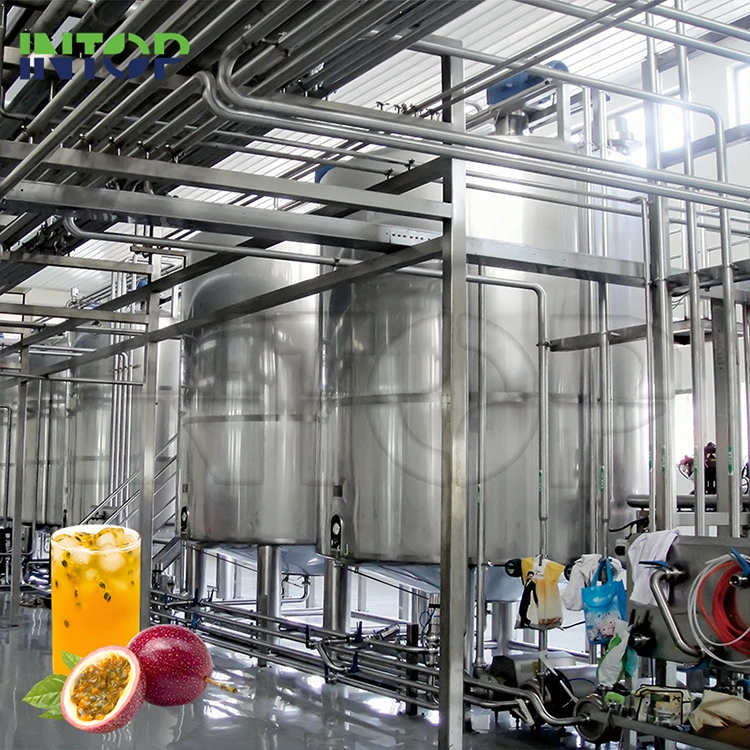
Hubei INTOP Machinery Co., Ltd. builds juice extraction machines and complete juice production lines from its own factory in Anlu, Hubei. Tell us your fruit, your target product and your hourly capacity, and we will work out which machine fits and how the rest of the line should be sized around it.
Related News
- Tubular UHT Sterilizer Technology Advances Support the Growth of Aseptic Beverage Processing
- What Makes a Strawberry Juice Production Line Efficient, Safe, and Ready for Commercial Scale?
- Bottled Water Production Line: 10 Factors Before Investment
- How to Build a Juice Production Line That Handles Multiple Fruit Types
- What It Takes to Scale an Energy Drink Production Line for Global Demand
- How Does a Water Treatment System Work in a Beverage Production Line?
Leave me a message