English
- English
- Afrikaans
- беларускі
- Hrvatski
- lugha ya Kiswahili
- ქართული
- Кыргыз тили
- Монгол хэл
- IsiXhosa
- Somali
- O'zbek
- Hawaiian
- Հայերեն
- Español
- Português
- русский
- Français
- 日本語
- Deutsch
- tiếng Việt
- Italiano
- Nederlands
- ภาษาไทย
- Polski
- 한국어
- Svenska
- magyar
- Malay
- বাংলা ভাষার
- Dansk
- Suomi
- हिन्दी
- Pilipino
- Türkçe
- Gaeilge
- العربية
- Indonesia
- تمل
- ελληνικά
- український
- فارسی
- български
- ລາວ
- Latine
- Қазақша
- Azərbaycan
- Македонски
- Lietuvos
- Română
- Srpski језик

How Does a Water Treatment System Work in a Beverage Production Line?
With increasing requirements for product safety and process stability, Intop Machinery emphasizes the importance of water treatment system design in modern beverage and dairy production, where water quality influences equipment performance and final product consistency.
Most buyers focus on the main process equipment—the UHT, the filler, and the CIP. But water is what touches every part of your product, from the boiler feed to the final rinse. If the water isn't right, nothing downstream works right.
A complete water treatment system for a beverage or dairy line typically includes three to five stages, scaled to your hourly output and your source water quality.
Sand Filter and Activated Carbon—The Pre-Treatment Stage
Raw water—whether from a municipal supply, a borehole, or a river intake—carries suspended solids, chlorine, and organic matter. A sand filter knocks out the larger particles. An activated carbon filter takes out chlorine and the smell/taste compounds that would otherwise carry through into the finished product.
This stage looks boring, but skipping it burns out your RO membranes within months. Anyone quoting you a water treatment package without adequate pre-treatment is selling you a future membrane replacement bill.
RO System—The Core of the Line
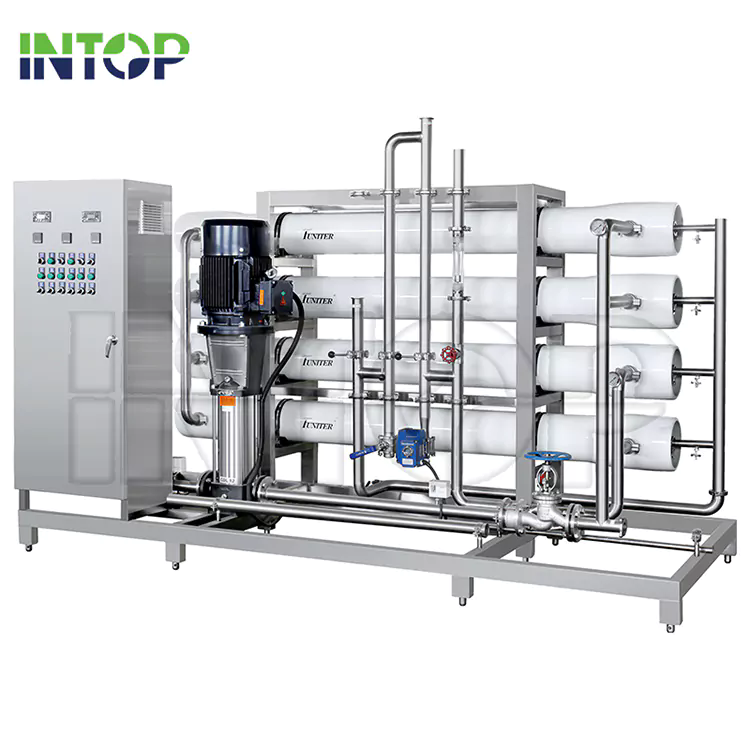
Reverse osmosis is where most of the purification happens. Water is pushed through a semi-permeable membrane at high pressure, typically 10-15 bar for brackish water, higher for seawater. The membrane rejects 95-99% of dissolved salts, bacteria, and most organic molecules.
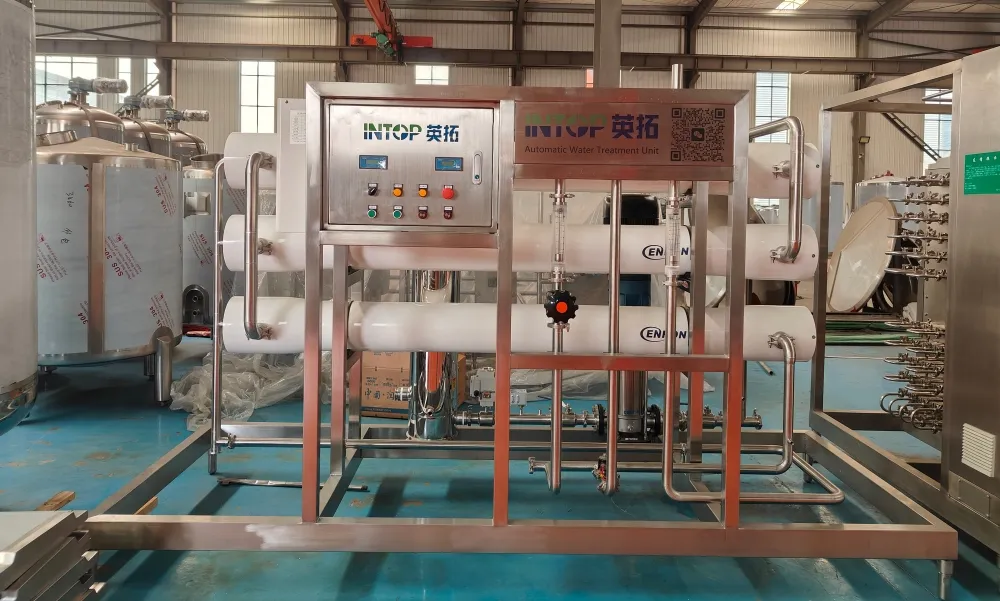
Recovery rate matters more than most buyers realize. A standard RO runs at 50-75% recovery—meaning for every 100 liters in, you get 50-75 liters of permeate. Higher recovery is possible but pushes scaling risk up. For a beverage line running 12 hours a day, that difference in recovery adds up to thousands of liters per shift.
Mixed Bed Polisher or EDI—For Demanding Applications
If your end use is water-for-injection equivalent, or you're blending with sensitive flavors, a mixed bed ion exchanger or an EDI module brings conductivity down below 1 µS/cm. Most dairy and juice lines don't need this stage. Most pharmaceutical, cosmeceutical, or high-end water-dilution beverage applications do.
Storage and Distribution Loop
Treated water goes into a stainless storage tank, usually 304 or 316L depending on whether the water will be heated. From there, a distribution loop carries it to wherever the line needs it—ingredient water, CIP dilution, bottle rinse, or boiler feed. A UV sterilizer on the return line keeps the loop from recontaminating between uses.
What Intop Machinery Offers
Intop machinery supplies complete water treatment systems sized from 500 L/h to 20,000+ L/h, with source water analysis and customized membrane selection. RO systems include CIP-compatible piping and pre-sterilization loops for beverage-grade or pharma-grade applications.
Send us your source water report (TDS, hardness, iron, chlorine) and target output volume. We'll come back with a stage-by-stage configuration, recovery target, and the consumables schedule you'll need to budget for.
Related News
- How to Choose a Juice Extraction Machine for Your Juice Production Line
- Tubular UHT Sterilizer Technology Advances Support the Growth of Aseptic Beverage Processing
- What Makes a Strawberry Juice Production Line Efficient, Safe, and Ready for Commercial Scale?
- Bottled Water Production Line: 10 Factors Before Investment
- How to Build a Juice Production Line That Handles Multiple Fruit Types
- What It Takes to Scale an Energy Drink Production Line for Global Demand
Leave me a message