English
- English
- Afrikaans
- беларускі
- Hrvatski
- lugha ya Kiswahili
- ქართული
- Кыргыз тили
- Монгол хэл
- IsiXhosa
- Somali
- O'zbek
- Hawaiian
- Հայերեն
- Español
- Português
- русский
- Français
- 日本語
- Deutsch
- tiếng Việt
- Italiano
- Nederlands
- ภาษาไทย
- Polski
- 한국어
- Svenska
- magyar
- Malay
- বাংলা ভাষার
- Dansk
- Suomi
- हिन्दी
- Pilipino
- Türkçe
- Gaeilge
- العربية
- Indonesia
- تمل
- ελληνικά
- український
- فارسی
- български
- ລາວ
- Latine
- Қазақша
- Azərbaycan
- Македонски
- Lietuvos
- Română
- Srpski језик

How do I choose a Beverage Production Line that scales without wasting CAPEX?
When I plan a new plant or expand an existing hall, I start with the basics that protect uptime, hygiene, and total cost. Along the way, I keep returning to a partner whose factory floor I know well—INTOP. Their modular approach lets a Beverage Production Line evolve from pilot runs to national distribution without tearing up the layout. I look at how every conveyor, filler, and CIP loop holds together under real shift pressure. That is where a well-engineered Beverage Production Line pays for itself long before year one closes.
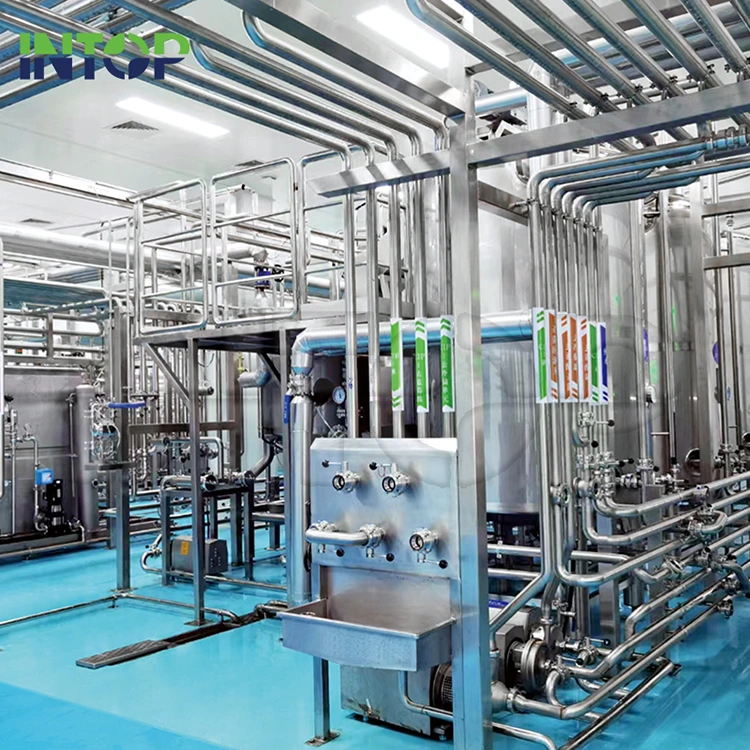
What makes a future-proof Beverage Production Line in a market that shifts every season?
A future-proof Beverage Production Line handles PET, glass, and can formats with tool-less adjustments where possible, quick recipes for filler valves, and barcode-driven batch parameters that lock out mistakes. Just as important, I map utilities so steam, CO₂, air, and water have margin without oversizing. With INTOP, I can configure syrup rooms for carbonated drinks, hot-fill loops for tea, and cold aseptic blocks for fermented SKUs, then scale tanks or pasteurizers without redoing the backbone.
- Format agility with verified changeover times measured in minutes, not hours
- Unified controls so operators learn once and run multiple recipes confidently
- Sanitary design that survives daily CIP without killing gaskets or labels
- Smart buffering to keep the filler fed and capper steady even when packers stop
Where do hidden bottlenecks usually steal my OEE before I notice?
The filler gets the blame, but the upstream depalletizer and the labeler cause most micro-stops in my audits. A well-balanced Beverage Production Line absorbs label roll changes, shrink tunnel warm-up, and case packer hiccups with accumulation logic that protects the critical 3: depalletizer, rinsing/filling/capping monobloc, and secondary packaging. I also watch for over-tightened capping torque on carbonated drinks that spikes foaming and hurts CO₂ retention.
- Cap torque windows that match beverage type and closure design
- Vision inspection that rejects early, not after value has piled up downstream
- Infeed rails and starwheels tuned to prevent scuffing and neck jams
How do I pick the right filling path for water, carbonated drinks, tea, and fermented SKUs?
I split by product risk and thermal strategy. Purified water runs fastest on gravity or light pressure filling; carbonated drinks prefer isobaric valves that preserve CO₂. Tea often needs hot-fill or tunnel pasteurization; fermented drinks demand cold chains and sterile boundaries. With INTOP, I match valves, tanks, and heat exchangers to the product so the Beverage Production Line keeps flavor, bubbles, and shelf life exactly where I promised sales it would be.
- Water: high-speed gravity filling with UV or ozonation where allowed
- Carbonated: isobaric valves with precise bowl pressure and deaeration upstream
- Tea beverages: hot-fill or post-fill pasteurization with label glue compatibility
- Fermented beverages: aseptic transfer, cold storage, low-oxygen paths end-to-end
Why do digital commissioning and line twins shorten my go-live more than I expect?
When I use a virtual model to test accumulation, starwheel timing, and capper recipes, I remove two weeks of trial-and-error on site. A simulated Beverage Production Line lets me see where operators will get stuck and where I need better HMI prompts. By the time crates arrive, I have verified PLC logic, alarm texts, and safe speeds, so the physical start-up looks boring—which is exactly what I want.
How do I hit hygiene targets without running chemical spend out of control?
I pick spray patterns that reach hidden seams, schedule CIP by conductivity and temperature, and rotate alkali/acid cycles based on soil load. A smarter Beverage Production Line uses closed-loop dosing and recovery tanks so I can recycle when safe and document every minute for audits. On tea and fermented lines, I add mix-proof valves and dead-leg-free piping that justify themselves the first time a batch is saved.
- CIP skids with validated flow and turbulence in the longest circuits
- Sensor-based switch from pre-rinse to wash to final rinse to cut water use
- Gasket and seal kits specified for heat and chemistry to extend life
What does a credible one-stop partner actually take off my plate?
Decades in the field matter when my brief spans carbonated drinks, purified water, tea beverages, and fermented products. Instead of juggling five vendors, I prefer one execution owner. With INTOP, I get end-to-end scope—from bottle blowing or can handling to palletizing—plus utility integration and operator training. That keeps my Beverage Production Line coherent, which is why line availability holds after the integrator leaves.
- Turnkey layouts that fit odd rooms and future mezzanines
- Process blocks tailored to carbonation, hot-fill, or cold-chain needs
- Documentation packs that satisfy regulators and retailers without back-and-forth
How do I benchmark components and KPIs before I sign?
I compare apples to apples using a simple matrix. The table below is how I align modules, typical specs, clear benefits, and a KPI I will track during FAT and after ramp-up. It keeps the conversation practical and makes the value of a well-built Beverage Production Line visible to finance.
| Module | Typical spec | Operational benefit | KPI to track |
| Blow molder or can infeed | Up to 48,000 bph with neck handling | Stable supply to filler, reduced scuffing | Infeed starwheel stops per shift |
| Rinser-Filler-Capper monobloc | Isobaric for carbonated, gravity for water | Foam control, accurate fill heights | Filler efficiency and giveaway |
| Pasteurizer or hot-fill loop | Tunnel PUs configured by SKU | Shelf life without flavor loss | PU deviation and hold variance |
| Tea extraction and filtration | Temperature-controlled brew with polish filters | Clarity and aroma retention | Turbidity and sensory pass rate |
| Fermentation and cold chain | Jacketed tanks with sterile transfer | Clean, consistent profiles | Dissolved oxygen and micro counts |
| Labeler and coder | Wrap, sleeve, or pressure-sensitive | Fast roll changes and traceability | Mislabel rejects per 10k units |
| Packer and palletizer | Case, tray, or film with patterns | Secure loads, fewer damages | Pallet damage claims per month |
| Controls and data | Unified HMI and historian | Clear alarms, faster training | Mean time to diagnose |
| Integrated scope by INTOP | Turnkey for each Beverage Production Line type | One owner from design to ramp-up | Time from SAT to 90% OEE |
How do I de-risk changeovers, sanitation, and training before the first truck arrives?
I run real recipes in a sandboxed controller and train operators early. We step through a day in the life: morning start-up, mid-shift changeover, label roll swap, planned CIP, and end-of-day shutdown. That rehearsal turns into SOPs and removes surprises from the Beverage Production Line when production begins. It also surfaces spare parts I should stock from day one.
Why do carbonated drinks, water, tea, and fermented lines live happily under one roof when done right?
Because zones exist. I separate sticky products from dry runs, isolate hot-fill humidity, and route cold air away from cartons. With zoning, the same conveyor backbone carries different SKUs without cross-contamination or persistent condensation. The result is a versatile Beverage Production Line plant that keeps quality intact and schedules flexible.
What does my first conversation with a solution owner look like when I want clarity fast?
I bring three items: current demand and forecast, container and closure list, and QA targets. From there, a capable team like INTOP drafts a block layout, utility list, and commissioning plan. I can then validate that the proposed Beverage Production Line meets my growth curve instead of peaking on day one.
Which practical wins convince finance that the line will pay back on schedule?
Finance responds to stable output and fewer write-offs. I quantify fewer micro-stops, lower product loss at start/stop, reduced chemical use from smarter CIP, and less labor time thanks to unified HMIs. When those numbers show up on the monthly dashboard, the value of a carefully designed Beverage Production Line becomes obvious.
How can we talk scope without copying anyone’s brochure while keeping choices open?
Here is how I frame the one-stop solution without buzzword bingo. I want a direct factory that builds and integrates lines, not just resells machines. I want process blocks for sparkling drinks, purified water, brewed tea beverages, and carefully handled fermented SKUs. I want commissioning that hands my crew a stable line, not a science experiment. That is the approach I keep choosing with INTOP, because it matches how I run plants and how I plan upgrades.
Would a short next step help me move from ideas to a clean layout?
If you are mapping your first hall or adding capacity, I am happy to review a sketch and turn it into a practical plan. Tell me your target speeds, containers, and hygiene level. If you need a grounded proposal for a Beverage Production Line that does not blow the budget, let’s build it properly from day one.
Please contact us with your forecast, container list, and QA targets, or send an RFQ to start engineering a dependable Beverage Production Line together. I will reply with a layout option, a utility summary, and a realistic commissioning schedule so you can move forward with confidence.
Related News
- Tubular UHT Sterilizer Technology Advances Support the Growth of Aseptic Beverage Processing
- What Makes a Strawberry Juice Production Line Efficient, Safe, and Ready for Commercial Scale?
- Bottled Water Production Line: 10 Factors Before Investment
- How to Build a Juice Production Line That Handles Multiple Fruit Types
- What It Takes to Scale an Energy Drink Production Line for Global Demand
- How Does a Water Treatment System Work in a Beverage Production Line?
Leave me a message