English
- English
- Afrikaans
- беларускі
- Hrvatski
- lugha ya Kiswahili
- ქართული
- Кыргыз тили
- Монгол хэл
- IsiXhosa
- Somali
- O'zbek
- Hawaiian
- Հայերեն
- Español
- Português
- русский
- Français
- 日本語
- Deutsch
- tiếng Việt
- Italiano
- Nederlands
- ภาษาไทย
- Polski
- 한국어
- Svenska
- magyar
- Malay
- বাংলা ভাষার
- Dansk
- Suomi
- हिन्दी
- Pilipino
- Türkçe
- Gaeilge
- العربية
- Indonesia
- تمل
- ελληνικά
- український
- فارسی
- български
- ລາວ
- Latine
- Қазақша
- Azərbaycan
- Македонски
- Lietuvos
- Română
- Srpski језик

How Can the Right Water Treatment System Turn Problem Water into a Reliable Asset for My Business?
When I started looking seriously at upgrading our existing water treatment system, I realised that most of our headaches did not come from “water” itself but from how we were managing it. Hidden operating costs, inconsistent effluent quality, and the constant risk of non-compliance were slowly eroding our margins. As I compared different solutions, I kept coming back to how Intop designs complete process lines rather than just selling individual machines. That mindset helped me rethink our own setup: instead of treating the system as a black box that “somehow cleans water”, I began to see it as a controllable, measurable tool that could turn problematic feed water into a reliable resource for production, cleaning, or reuse.
In this article, I want to walk through the key questions I asked myself on that journey. I will share how I translated real-world pain points into technical requirements, what components I prioritised, and how a well-structured water treatment system can quietly protect both product quality and the bottom line. My goal is simple: if you are planning or upgrading a project, you should be able to read this and say, “I know exactly what to check before I send out a request for quotation.”

Contents
- Why does my facility struggle with consistent water quality?
- What core components make a modern water treatment system truly effective?
- How do I map my real-world pain points to a tailored water treatment system?
- Which performance indicators should I track to judge my water treatment investment?
- What practical steps can I take to reduce operating costs without risking water safety?
- How does Intop help me upgrade or scale my existing water treatment system without disrupting production?
- What key questions do buyers usually ask before choosing a water treatment system?
- Conclusion
Why does my facility struggle with consistent water quality?
When I audit a plant that has recurring water issues, I rarely find a single dramatic failure. Instead, I see a series of small mismatches between the incoming water, the process requirements, and the way the water treatment system is operated day to day. Sometimes the source water changes seasonally; sometimes the production line has expanded while the original design capacity has stayed the same. In many cases, the operators are simply doing their best with limited data and legacy equipment.
To understand why water quality is unstable, I usually start with three basic questions:
- Where is my water coming from now, and how might it change over time? Groundwater, municipal supply, surface water, or recycled process water all bring different risks and contaminants.
- What are the most sensitive points in my production process? For example, boiler feed water, food-contact washing steps, or any step that affects final product appearance, safety, or taste.
- How am I currently monitoring and logging water quality? If I only see lab results once a week, I am effectively operating blind for the other six days.
When I looked at Intop solutions, one thing that stood out was how clearly the process flow is mapped from raw water to final use. Rather than treating “inlet” and “outlet” as vague boxes, each stage is defined with its own target parameters and alarms. That structure made it easier for me to identify where my own system was underperforming, and where a modular upgrade could fix the problem without rebuilding everything from scratch.
What core components make a modern water treatment system truly effective?
Every project is unique, but when I break down a modern water treatment system, I tend to see the same functional blocks repeating in different configurations. Understanding these blocks helped me read P&IDs and proposals more confidently, and it also helped me explain the logic to stakeholders who are not engineers.
The key building blocks usually include:
- Intake and pre-treatment – Screens, grit removal, and sometimes chemical dosing to stabilise pH or reduce hardness before finer filtration.
- Primary filtration – Media filters, cartridge filters, or membrane modules that remove suspended solids and protect downstream equipment.
- Advanced treatment – Ultrafiltration, reverse osmosis, or specialised resins when I need very low conductivity, low TOC, or the removal of specific ions or metals.
- Disinfection – UV, ozone, or controlled chemical disinfection to keep microbial counts under control, especially for food, beverage, or pharmaceutical applications.
- Storage and distribution – Tanks, pumps, and control valves that maintain pressure, prevent recontamination, and ensure a stable supply across the site.
- Automation and monitoring – PLCs, sensors, and remote monitoring interfaces that convert complex processes into clear, actionable information.
What I appreciate about working with a structured supplier such as Intop is that these blocks are not treated as isolated islands. The equipment is selected and sized as a system, so that the flow, pressure, and quality targets are aligned. For example, membranes are specified not just by nominal capacity but by expected fouling rate based on actual feed water analysis, and the pre-filtration is chosen accordingly.
How do I map my real-world pain points to a tailored water treatment system?
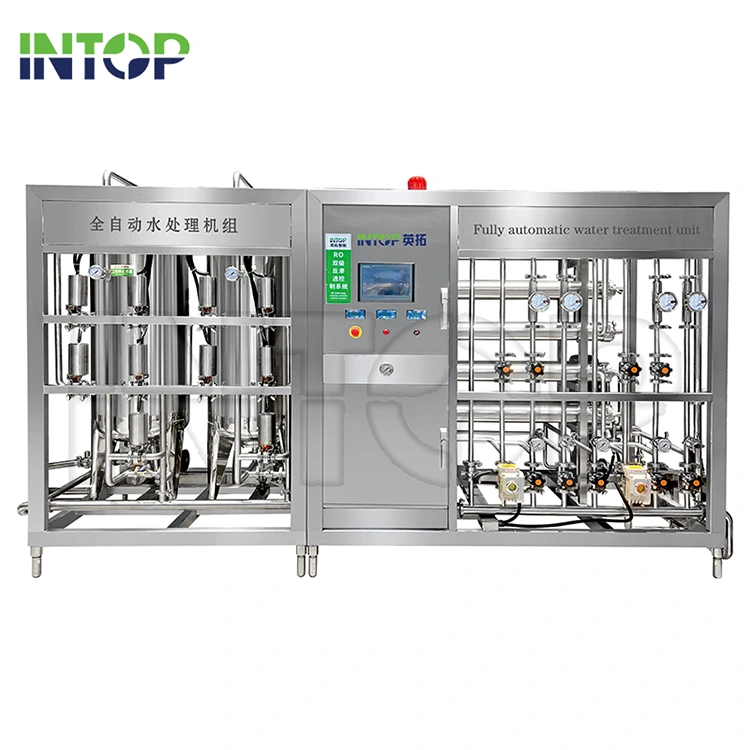
A lot of people start their project by asking, “What capacity do I need?” I prefer to begin with a different question: “Which risks do I want my water treatment system to eliminate?” When I frame the discussion this way, the conversation becomes much more concrete, and the final design is easier to justify to management.
Here is the simple framework I use when translating pain points into design requirements:
- List the most expensive or dangerous failures you have faced in the past three years. Examples include rejected batches, damaged equipment, unexpected downtime, or non-compliance notices.
- Trace each failure back to a measurable water quality parameter. Turbidity, hardness, microbial counts, COD, salinity, and specific ions are common culprits.
- Set realistic target values and safety margins. I do this collaboratively with process engineers, quality managers, and the supplier’s technical team.
- Decide how much redundancy you are comfortable paying for. Parallel filters, backup dosing systems, or spare pumps can look expensive on paper but cheap compared to an extended shutdown.
- Align maintenance practices with design assumptions. If the design assumes filter backwashing every eight hours, I need to be honest about whether that can actually happen on site.
When I worked through this exercise with an Intop engineer, we ended up discarding some “nice-to-have” ideas and focusing on the stages that directly protected product quality and compliance. The result was not the most complicated layout, but it was the one that answered our actual problems instead of an abstract list of features.
Which performance indicators should I track to judge my water treatment investment?
Once a new system goes live, the real challenge begins: proving that the investment is paying off. I learned very quickly that “the water looks clear” is not a performance indicator. To have a meaningful conversation with management about our water treatment system, I needed a small set of metrics that we could track continuously and relate to cost or risk reduction.
Below is a simplified table I use to structure those discussions. The specific numbers will vary by project, but the logic applies across many industries:
| Indicator | What I Monitor | Why It Matters | Typical Target Trend |
|---|---|---|---|
| Product water quality | Conductivity, turbidity, key ions, microbial counts | Directly linked to product safety, taste, and equipment protection | Stable within specification, fewer out-of-range events |
| System availability | Uptime percentage vs. planned production hours | Impacts ability to run shifts without interruption or tankering water | Consistently above the agreed uptime target (e.g. 95–98%) |
| Operating cost per m³ | Energy, chemicals, consumables, labour per cubic metre treated | Shows whether the system is becoming more efficient or drifting over time | Gradual reduction as operations are optimised |
| Waste volume and quality | Concentrate or sludge volume, discharge parameters | Affects disposal fees, regulatory compliance, and sustainability goals | Reduced volume and more predictable quality |
| Unplanned maintenance events | Number of breakdowns, emergency interventions per quarter | Reflects how well the system design and preventive maintenance are working | Decreasing trend as issues are identified and resolved |
By structuring the conversation around these indicators, I could show that an integrated solution from Intop was not just “new equipment” but a measurable improvement in risk control and running cost. That made it easier to plan future expansions or upgrades based on real data instead of guesswork.
What practical steps can I take to reduce operating costs without risking water safety?
One of my biggest worries before upgrading was that a more advanced system would automatically mean higher running costs. In practice, I found that a well-engineered water treatment system can often reduce both risk and cost when it is operated intelligently.
These are the cost-control steps that made the most difference for me:
- Optimising chemical dosing. Instead of fixed, conservative dosing rates, I worked with the supplier to implement dosing that responds to real-time quality data. This reduced overuse of chemicals while keeping safety margins intact.
- Improving pre-treatment. Better pre-filtration reduced membrane fouling and extended cleaning intervals, which lowered downtime and extended the life of expensive components.
- Recovering and reusing water where practical. In some cases, we could reuse treated water for non-critical applications such as cleaning or cooling, reducing total intake volumes.
- Automating routine checks. Simple alarms and trend reports helped operators intervene early, before small issues turned into expensive failures.
- Planning maintenance with data, not just calendars. By tracking pressure drops, flow rates, and energy use, we could plan service activities based on actual condition rather than fixed intervals.
The key lesson for me was that cost control is not about cutting corners. It is about designing and running the system so that every kilowatt-hour and every litre of water actually supports a clear business objective.
How does Intop help me upgrade or scale my existing water treatment system without disrupting production?
Stopping production for weeks just to rebuild a utility system is not an option for most businesses, and it was certainly not an option for us. That is why I paid special attention to how easy it would be to phase in a new water treatment system from Intop alongside our existing setup.
The approach we adopted involved three ideas that I now recommend to anyone planning a similar project:
- Containerised or skid-mounted modules. Pre-assembled units can be delivered, connected, and tested with minimal on-site fabrication. This shortens installation time and reduces disruption.
- Parallel operation during transition. For a period, the new and old systems can run side by side. This gives operators time to learn the new controls and provides a safety net while any tuning issues are solved.
- Clear integration with existing utilities. Piping, electrical, and control interfaces should be agreed in detail before equipment arrives on site. Having a supplier like Intop who understands full-line integration makes this step smoother.
Because the system was modular, capacity expansion later on became far less intimidating. Instead of redesigning everything, we could add or upgrade specific stages as production volumes changed, keeping the investment curve aligned with real demand.
What key questions do buyers usually ask before choosing a water treatment system?
Below are some of the questions I hear most often when people are preparing to invest in a new solution, along with the answers I share based on my own experience with modern systems and with Intop projects.
Q1. How do I know if my current water treatment setup is undersized?
A. I start by comparing actual peak demand with the design capacity and checking how often storage tanks run critically low. If I see frequent production slowdowns, repeated alarms, or operators bypassing treatment steps just to keep up, that is a strong sign the system is undersized. Lab data can confirm this when quality drifts out of specification during high-demand periods. At that point, I look at whether we can add modules to the existing system or whether a new, integrated design is more cost-effective.
Q2. How long does it usually take for a water treatment investment to pay back?
A. Payback depends on local water tariffs, discharge fees, and the cost of quality failures. In my case, the strongest financial gains came from reduced product losses, lower chemical consumption, and fewer shutdowns. Once we quantified these savings and compared them against the capital and operating costs of the new system, the payback period became clear. For many industrial users, a well-designed system can justify itself within a few years, especially when reuse or recycling is part of the design.
Q3. Do I really need advanced automation, or is manual control enough?
A. Manual control can work in very small or stable operations, but as soon as feed water quality or production schedules vary, the lack of automation becomes risky. With a properly configured PLC and human–machine interface, operators can see trends, alarms, and setpoints at a glance. This reduces human error, speeds up troubleshooting, and makes it easier to maintain consistent quality. In my experience, the extra investment in automation quickly pays off in reduced labour costs and fewer incidents.
Q4. How should I plan for future expansion when sizing my system today?
A. I try to be realistic rather than optimistic. Instead of designing for a distant “maximum dream capacity,” I choose a system that can handle certified short-term growth and that is modular enough to be expanded later. This is where modular solutions from suppliers like Intop are helpful: I can start with a core capacity and keep connection points ready for future modules, avoiding large upfront oversizing.
Q5. What kind of maintenance expertise will my team need?
A. The answer depends on how complex your chosen technology is. For most industrial projects, technicians should understand filter handling, pump basics, chemical safety, and simple instrumentation. Beyond that, I rely on the supplier to provide clear manuals, training, and, ideally, remote support. What matters most is that the system is designed with maintainability in mind—components accessible, standard spare parts, and intuitive fault diagnosis screens.
Q6. How can I make sure the system stays compliant with local regulations?
A. I always start with the legal discharge and product water requirements for my region and industry. Then I work with the supplier’s engineering team to build those limits into the design and control philosophy. Regular sampling, calibration of instruments, and documented procedures for handling deviations are essential. When a partner like Intop understands both the technical and regulatory aspects, staying compliant becomes part of daily routine rather than a separate project.
Q7. What should I look for when comparing proposals from different suppliers?
A. I compare more than just price and capacity. I look closely at the process flow diagram, component lists, power consumption estimates, chemical consumption rates, expected maintenance intervals, and the level of automation. I also pay attention to how clearly the supplier explains their choices. If a proposal from a company like Intop makes it easy for me to see why each stage exists and how it protects my process, that transparency gives me confidence that the design is robust.
Q8. Can one water treatment solution handle both process water and wastewater?
A. In some cases, yes, a single integrated platform can manage both, but I usually treat them as separate streams with different quality targets. Process water often needs high purity and stability, while wastewater treatment focuses on safe discharge and cost-effective removal of contaminants. A flexible design can share certain components or control systems, especially when supplied as an integrated package, but each stream should be engineered for its own risks and regulations.
Conclusion
Looking back, upgrading our water treatment system was not just a technical decision; it was a strategic one. By treating water as a managed asset instead of a background utility, I was able to reduce risk, stabilise product quality, and create a clearer roadmap for future expansion. Working with a partner like Intop, who understands both individual pieces of equipment and the way they interact as a complete line, made it much easier to move from vague concerns to a concrete, well-documented solution.
If you are planning a new project or considering an upgrade, now is the moment to turn your own pain points into a clear specification. Define the risks you want to eliminate, the metrics you need to track, and the level of automation your team can support. Then, reach out to a technical team that can translate those needs into a practical design. If you are ready to take the next step, I encourage you to contact us, share your water quality data, and ask for a tailored proposal. A conversation today could be the starting point for a safer, more efficient, and more sustainable water future for your facility—so do not hesitate to contact us and send your inquiry now.
Related News
- Tubular UHT Sterilizer Technology Advances Support the Growth of Aseptic Beverage Processing
- What Makes a Strawberry Juice Production Line Efficient, Safe, and Ready for Commercial Scale?
- Bottled Water Production Line: 10 Factors Before Investment
- How to Build a Juice Production Line That Handles Multiple Fruit Types
- What It Takes to Scale an Energy Drink Production Line for Global Demand
- How Does a Water Treatment System Work in a Beverage Production Line?
Leave me a message